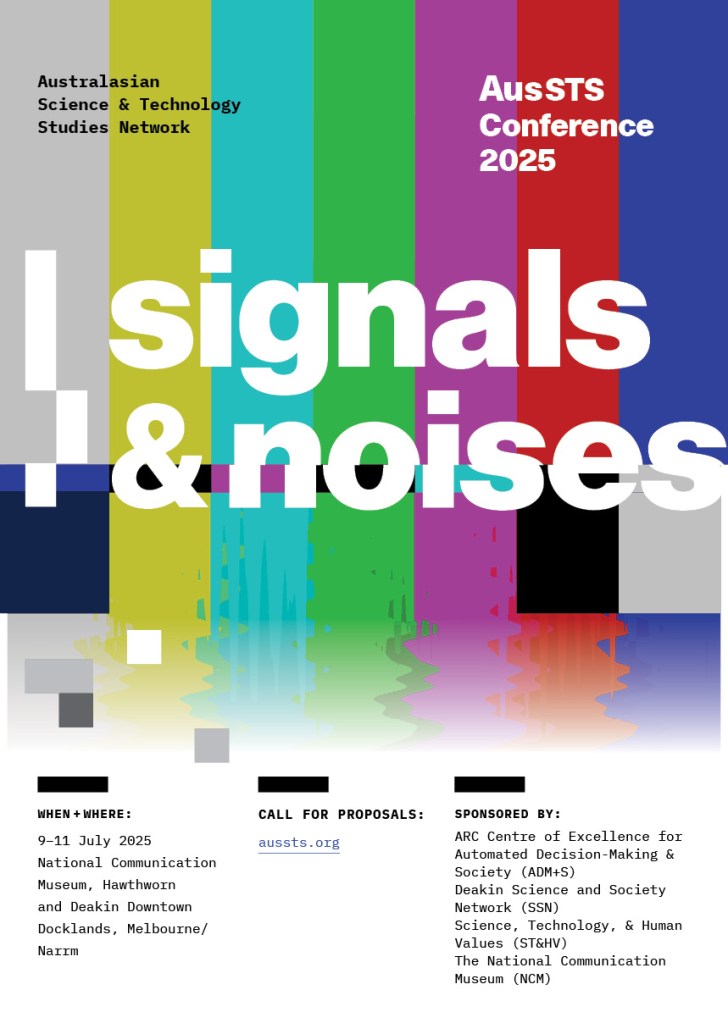
The Call for Proposals for the AusSTS 2025 conference, ‘Signals and Noises’ to be held in Narrm/ Melbourne from 9-11 Julyis now closed.Please look out for responses and confirmation details in Early April.
For more information and details about the conference theme, please see below. Day 1 will take place at the National Communication Museum in Hawthorn, and day 2 and 3 at Deakin Downtown in Docklands. We look forward to seeing you in July!
AusSTS 2025 seeks to bring the broad scope of STS subjects, skills, practices and politics into conversation with a core problematic of information theory – the problem of noise.
Sociality – be it more-than-human, cybernetic, embodied, urban, queer or quotidian – is premised on signalling.
Any signal – a symptom, a code, a cry, a whisper – is predicated on noise.
Shannon and Weaver famously defined noise as those changes or unintended things which trouble the signal – such as distortions, static, errors in transmission.
Noise (as distortion, as error) is a problem for communication – it corrupts and contaminates communication signals (as they fly along wires or along undersea cables for example). But to eliminate noise entirely is to shut signals down, to sever communication. To perfectly silence noise would also mean perfectly silencing the signal to which it belongs. Signal and noise are intimately, iteratively bonded in their material production, reception and translation. What questions then might signals and noises ask of STS? Is it simply a case, as it was for Shannon and Weaver (1949) of eliminating noise as far as possible in the service of signal? Or can we listen to ‘noise’ differently? Can the difference between what we seek to understand or convey on the one hand, and the ‘unintended things’ that trouble our efforts on the other, be illustrative? How might we work creatively with the flotsam and jetsam of research, or trace the twisting journeys of signals?
Indeed, noise demands to make itself heard across many domains that STS attends to. In the environmental sciences, practices of monitoring places and events have transposed the reading of the natural world into data signals and measurable points. In public health and biomedicine, monitoring bodies and bodily traces give rise to new techniques seeking to produce a clear signal out of the ‘noise’ of the body. “There is no code in nature, however unnatural this may seem,” Foucault argued, “Illness is happy just to “make noise”…it is medicine which does all the rest of it” (1966/2024). How then has medicine ‘heard’ the body in different ways over time, with new technologies and techniques of interpretation – and what challenge does the noise of the body pose for medical technoscience today?
Discerning between signal and noise is as much a political act as it is a technical one.
Feminist theory, Queer Studies, and Indigenous Studies have led the way in asking whose/which regimes of knowledge determine what counts as meaning (signal) and excess (noise)? Whose voices and bodies are deemed too noisy? And what forms of violence are committed along the way in making these distinctions? In defiance of these neat and orderly separations, movements such as cyberfeminism, xenofeminism, and glitch feminism have all embraced the subversive potential of noise as a mode of rupture and disruption, interrupting our regularly scheduled signals to deliver us new worlds of meaning.
Potential readings and interpretations
We encourage submissions that grapple with the entwined nature of signals and noises in our efforts to understand the world and listen to noise differently. We invite generous readings of the theme. Possible interpretations include, but are not limited to:
Bodily signals: how do we read and interpret the different signals of the body across technoscientific practice, such as biometrics, genomics, disease monitoring, and more?
Environmental signals: how do we filter the clear and messy signals emanating from the Anthropocene, including waste, pollution, and climate change?
Computational signals: how is the world being made machine-readable and individuals, populations, and environments monitored, targeted, assessed based on variables of signals and noise?
Error as noise: how are events such as errors, glitches, breakdowns attributed to the non-productivity of noise and how can they be recuperated?
Waste as noise: how are entities labelled ‘waste’ (such as weeds, human bodily waste, chemicals and other toxic elements) cast out as noise to any otherwise healthy system?
Practices of filtering, purification, valuation: what are the material practices of differentiation that maintain the boundaries between signal and noise?
Signal-to-Noise Politics: what are the social and political dimensions of noises and signals, including their use in surveillance, control, and marginalization, as well as its impact on specific groups and publics?
Signals otherwise: how are Indigenous and queer meanings and non-meanings, signals and noises, being mobilised and contested? How do activist and intellectual movements (e.g. feminist, anti-colonial, anti-racist) help to rupture, disrupt, and intervene in oppressive orders that value signal over noise?
Join us as we tune in to the signals and noises that shape our understanding of science, technology, and the worlds around us. We invite scholars, writers, artists, and activists from any career stage to contribute to AusSTS 2025. We welcome applications that broadly engage with STS, and especially encourage applicants to engage with the conference theme where possible. Indigenous people at all stages of their careers are strongly encouraged to submit an application, with free registration offered for all Indigenous participants.
Confirmed keynotes, collaborations and guests
We are excited to announce a collaboration with the ‘Signal to Noise’ exhibition at the fantastic new National Communication Museum (NCM) in Hawthorn, Naarm, for day 1 of the conference. The day 1 activities will draw on the creative archives, exhibitions and interactive spaces in the NCM and have been made possible thanks to generous support from the ARC Centre of Excellence for Automated Decision-Making and Society (ADM+S).
Day 1 will include a keynote panel on infrastructures of noise with Dang Nguyen, (RMIT), Ranjodh Dhaliwal Singh, (University of Basel), Kate Mannell (Deakin) and Fabian Offert (University of California, Santa Barbara), as well as a series of workshops and a public event in the evening with Eryk Salvaggio and further international and national artists (to be announced soon!).
Day 2 and 3 will take place at Deakin Downtown in Docklands. We look forward to a keynote on technologies of reproduction by Elizabeth Stephens (University of Queensland), in discussion with Jaya Keaney (University of Melbourne), to kick off a day of presentations, pre-submitted paper workshops, and ‘Making and Doing’ sessions, which will include posters and short, timed tours where presenters will have a few minutes to introduce their installations.
Submit an abstract (200 words) for a short (10 minute) presentation that engages with the conference theme. Sessions will consist of 4-5 presentations followed by group discussion.
Submit an abstract (200 words) for a longer written work to be workshopped with attendees. These works can include draft articles or other manuscripts, more speculative proposals of research, and other creative or non-traditional forms of translation and output. Final submissions should be in a written format, between 2,000 and 3,000 words, and ready to be circulated amongst all attendees by 1 June 2025. Senior STS scholars will be allocated to each workshop session to contribute feedback.
Submit a proposal for a ‘Making and Doing STS knowledge’ session (see more details below)
Submit an EOI to host an AusSTS meet-up. Meet-ups are less formal social gatherings or meetings of like-minded scholars. Conference organisers will connect meet-up hosts and attendees during the registration process. Hosts are requested to submit a 200 word description of their meet-up.
Making and Doing
We invite scholars to play with the materiality of communication, the aesthetics of feedback and the epistemic politics of form. This session encourages speculative, participatory and/or aesthetic engagements with the signals and noises in and of our STS studies. This year we are expanding Making and Doing to include posters, encouraging non-linear accounts of research beyond the traditional paper format.
Presenters in this session will be offered a display space in which they may coordinate an interactive exhibit, poster, or schedule a small event inviting engagement with a presentation of STS knowledge making as practice and in practice. The session will also include the opportunity for presenters to introduce their contribution in a 3 minute segment of a coordinated tour undertaken by conference participants.
Making & Doing contribution submissions must consist of:
a title
the name/s of the contributor/s
a short description of what you are presenting (up to 200 words)
the form of your presented work (for example, displays of devices, an installation, a film, a performance, a workshop, a poster)
a description of the spatial and technical requirements of your display (up to 100 words)
a representative high quality image (if possible)
If you would like more specific information about this Making and Doing session or have an idea for a submission that you would like to discuss with the organisers, please contact Sophie Adams at s.adams@deakin.edu.au.
DAY 1 – National Communication Museum
This year’s AusSTS conference is excited to announce that it is partnering with the National Communication Museum to present a day of workshops, art performances, and public events to celebrate their Signals to Noise exhibition, curated by Joel Stern, Eryk Salvaggio, and Emily Siddons. This will take place on Day 1 of the conference (Wednesday July 9th) at the National Communication Museum in Hawthorn, Narrm. It will incorporate a keynote panel, material culture and publishing workshops and a public event. This day will have limited capacity – more details to be announced!
Questions? You can reach the convenors Christopher O’Neill and Carina Truyts at ausstsgrad@gmail.com.
Signals & Noises is sponsored by: ARC Centre of Excellence for Automated Decision-Making & Society (ADM+S); Deakin Science and Society Network; Science, Technology, & Human Values; and the National Communication Museum.

 AusSTS