
AusSTS2025 Annual Conference
9-11 July, 2025
National Communication Museum & Deakin Downtown, Melbourne/Narrm
Led by co-convenors Carina Truyts and Christopher O’Neill
Sociality – be it more-than-human, cybernetic, embodied, urban, queer or quotidian – is premised on signalling. Any signal – a symptom, a code, a cry, a whisper – is predicated on noise. Shannon and Weaver famously defined noise as those changes or unintended things which trouble the signal – such as distortions, static, errors in transmission.
Noise (as distortion, as error) is a problem for communication – it corrupts and contaminates communication signals (as they fly along wires or along undersea cables for example). But to eliminate noise entirely is to shut signals down, to sever communication. To perfectly silence noise would also mean perfectly silencing the signal to which it belongs. Signal and noise are intimately, iteratively bonded in their material production, reception and translation. What questions then might signals and noises ask of STS? Is it simply a case, as it was for Shannon and Weaver (1949) of eliminating noise as far as possible in the service of signal? Or can we listen to ‘noise’ differently? Can the difference between what we seek to understand or convey on the one hand, and the ‘unintended things’ that trouble our efforts on the other, be illustrative? How might we work creatively with the flotsam and jetsam of research, or trace the twisting journeys of signals?
Indeed, noise demands to make itself heard across many domains that STS attends to. In the environmental sciences, practices of monitoring places and events have transposed the reading of the natural world into data signals and measurable points. In public health and biomedicine, monitoring bodies and bodily traces give rise to new techniques seeking to produce a clear signal out of the ‘noise’ of the body. “There is no code in nature, however unnatural this may seem,” Foucault argued, “Illness is happy just to “make noise”…it is medicine which does all the rest of it” (1966/2024). How then has medicine ‘heard’ the body in different ways over time, with new technologies and techniques of interpretation – and what challenge does the noise of the body pose for medical technoscience today?
Twenty five panels across four streams showcasing short papers and workshops of research taking up the theme of ‘Signals and Noises’, as well as eleven ‘making and doing’ sessions exploring the theme through experimental, interactive, and artistic methods.
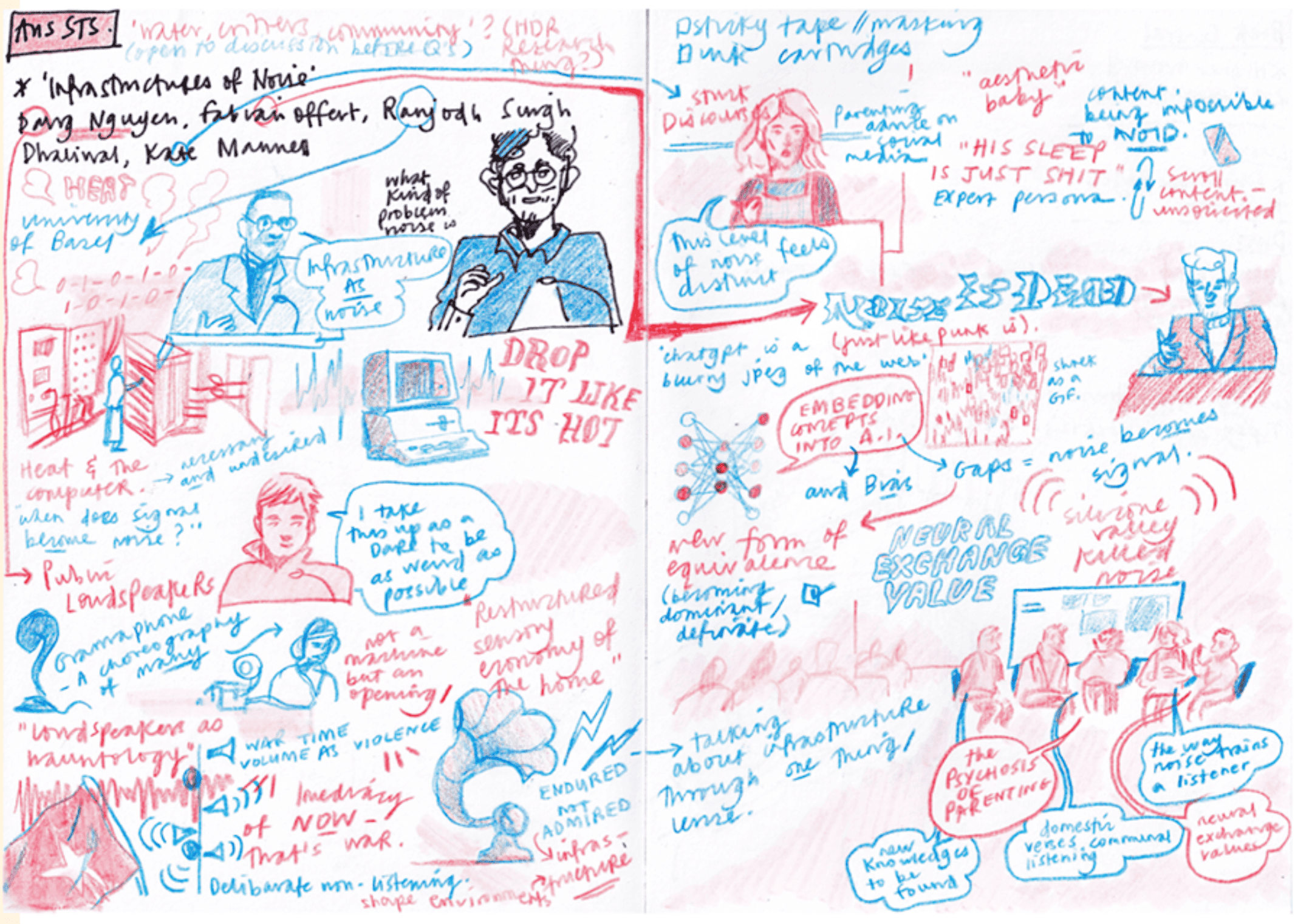
AusSTS member Holly O’Neil (University of Technology Sydney) has provided a wonderful reflection and recap of the event at Backchannels, the official blog of our partner organisation, The Society for Social Studies of Science (4S). You can find her reflections, including her illustrations as an ‘anthro-artist’, here.
The AusSTS 2025 conference was convened by the Melbourne node of AusSTS, led by Carina Truyts (Deakin) and Christopher O’Neill (Deakin), alongside Emma Kowal (Deakin), Glen Berman (ANU), Joel Stern (RMIT), Mardi Reardon-Smith (Monash), Sophie Adams (LaTrobe), Thao Phan (ANU), Timothy Neale (Deakin) and Tristan Duncan (Deakin).
The conference was organised in collaboration with the AusSTS network steering committee, which is situated across Sydney, Melbourne, Darwin, and Wellington.
AusSTS 2025 was hosted at Deakin Downtown and the National Communication Museum. The conference was aided by generous support from the ARC Centre of Excellence for Automated Decision-Making and Society, the Deakin Science and Society Network, and the journal Science, Technology and Human Values.
AusSTS acknowledges the Traditional Owners of the lands, skies, and waterways on which the conference took place. The National Communication Museum (NCM) is on the unceded lands of the Wurundjeri Woi-wurrung people of the Kulin Nation and Deakin Downtown is on the unceded land of Wadawurrung and Wurundjeri Woi-wurrung people. We pay respects to the Elders both past and present of these lands and the many other lands from which members of AusSTS come together.